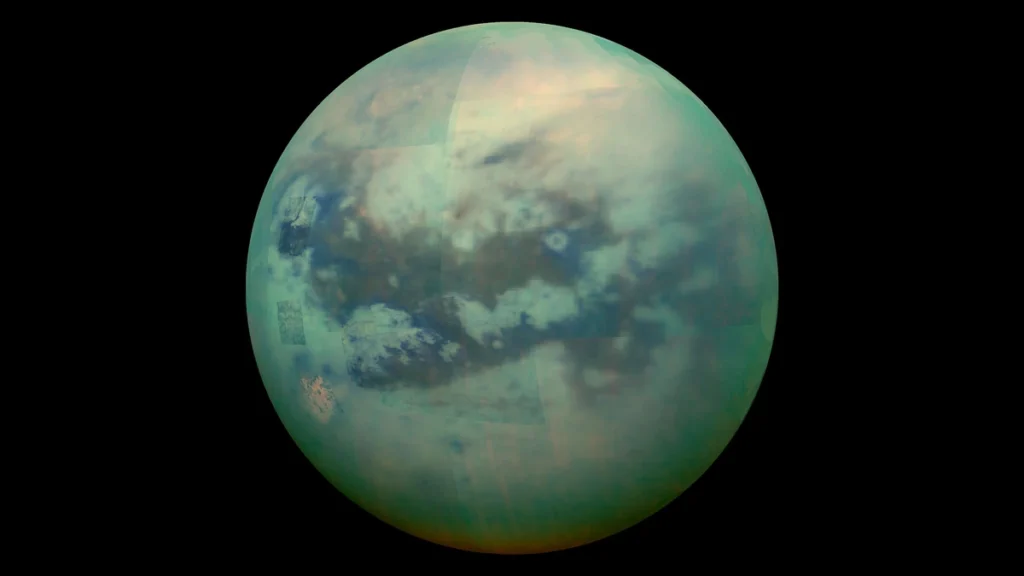

Okay, picture this: a world where it rains gasoline, lakes are made of liquid methane, and the ground is covered in hydrocarbon sand. Sounds like a sci-fi movie, right? Nope. It’s Titan , Saturn’s largest moon, and it’s weirder than anything Hollywood could dream up. What fascinates me is how scientists are trying to understand the strange chemistry that makes this alien world tick. And believe me, it’s a puzzle with pieces we’re only beginning to find.
Titan’s Hydrocarbon Cycle | A Deep Dive

Here’s the thing: Earth has a water cycle – evaporation, condensation, precipitation. Titan has a hydrocarbon cycle. Methane and ethane, which are gases on Earth, exist as liquids on Titan due to the frigid temperatures (around -179 degrees Celsius!). They evaporate, form clouds, and rain back down, filling lakes and rivers. It’s like Earth, but utterly, alienly different. But, why is this important? Understanding Titan’s hydrocarbon cycle helps us understand planetary processes in general, and potentially, the conditions needed for life to arise – even if that life is based on something other than water. The atmosphere is largely nitrogen, like Earth, with a smattering of methane, which breaks down due to sunlight and forms a host of more complex organic molecules. These molecules eventually fall to the surface, creating a sludge of hydrocarbons.
The ‘Why’ Behind the Mix | Unraveling the Mysteries
So, why does this “oil and water” mix matter? I mean, it’s cool and all, but what’s the big deal? Well, for starters, it challenges our assumptions about what makes a planet habitable. We tend to think of liquid water as essential for life, but Titan shows us that other liquids, like methane, could potentially play a similar role. This opens up the possibility of finding life in places we never thought to look before. A common mistake I see in discussions about Titan is dismissing it as simply “too cold” for life. While it’s true that life as we know it wouldn’t survive there, that doesn’t rule out the possibility of entirely different forms of life that could thrive in such conditions. Furthermore, studying Titan’s atmosphere can give us clues about the early Earth. It has a similar chemical composition to what Earth’s atmosphere may have looked like billions of years ago, before life drastically altered it.
The Role of Tholins | Titan’s Building Blocks
Let’s talk about tholins. These are complex organic molecules formed by the interaction of sunlight and atmospheric gases. They’re responsible for Titan’s hazy orange appearance, and they’re thought to be key ingredients in the moon’s surface chemistry. Imagine a giant chemistry experiment happening continuously in the atmosphere and on the ground. Tholins rain down, accumulating over time and creating a layer of organic goo. Scientists believe that these tholins could potentially form the building blocks of life, given the right conditions. They are formed as sunlight or cosmic rays break apart nitrogen and methane molecules in Titan’s atmosphere, initiating a cascade of chemical reactions. The resulting compounds condense into tiny particles that eventually coalesce and drift down to the surface.NASA’sresearch into tholins is ongoing, but it’s clear they play a crucial role in shaping Titan’s environment.
Future Missions and What They Might Uncover
The upcoming Dragonfly mission , slated to launch in the coming years, is set to explore Titan up close and personal. This rotorcraft lander will hop across the surface, analyzing the composition of the soil and searching for signs of prebiotic chemistry. What excites me most is the potential for Dragonfly to discover something completely unexpected. We’ve only scratched the surface of understanding Titan , and there’s no telling what secrets it might hold. Imagine discovering evidence of complex organic molecules, or even something that hints at the possibility of life. It would revolutionize our understanding of the universe and our place in it. Speaking of potential life, Dragonfly will be able to analyze the chemistry of Titan’s surface in multiple locations, helping scientists understand the distribution of key molecules and identify potential sites for future exploration. The information from this mission will provide invaluable insight into the moon’s intriguing environment.
The Significance of Studying Titan’s Methane Lakes
Okay, so Titan has lakes. Big deal, right? Wrong! These aren’t your average lakes – they’re made of liquid methane and ethane. What fascinates me is the role these lakes might play in Titan’s overall climate and chemistry. They could act as reservoirs for organic compounds, influencing the composition of the atmosphere and the surface. Also, the lakes could potentially harbor unique chemical reactions that aren’t possible on Earth. The processes involved with the methane lakes are complex, influencing everything from Titan’s weather patterns to the composition of its icy crust. Let me rephrase that for clarity: Titan’s lakes aren’t just pretty scenery; they’re integral components of a dynamic and fascinating world. Just like how Titan ‘s hydrocarbon cycle shapes its environment, understanding these liquid bodies is vital for a more complete picture of the moon.
And, if you are facing issue of lag in game then you can read this article how to fix lag instantly in call of duty mobile (codm) .
FAQ About Titan
What exactly are tholins, and why are they important?
Tholins are complex organic molecules formed in Titan’s atmosphere. They are considered building blocks of life.
Could there be life on Titan?
While not life as we know it, some scientists speculate that unique life forms could exist in Titan’s hydrocarbon-rich environment.
What is the Dragonfly mission, and what will it do?
Dragonfly is a NASA mission that will send a rotorcraft lander to Titan to analyze its surface and search for prebiotic chemistry.
What are Titan’s lakes made of?
Titan’s lakes are primarily composed of liquid methane and ethane, not water.
Why is Titan’s atmosphere similar to Earth’s?
Both atmospheres are primarily nitrogen.
Why study Titan’s hydrocarbon cycle?
Studying Titan’s cycle helps understand planetary processes and conditions for life, challenging our assumptions.
So, the next time you look up at Saturn, remember that its moon Titan is a world of strange beauty and scientific intrigue. It challenges our preconceptions about habitability and offers a glimpse into the potential for life beyond Earth, even in the most unexpected places. I also want to mention about nebula, read about it here lion nebula .


Leave feedback about this